

 By
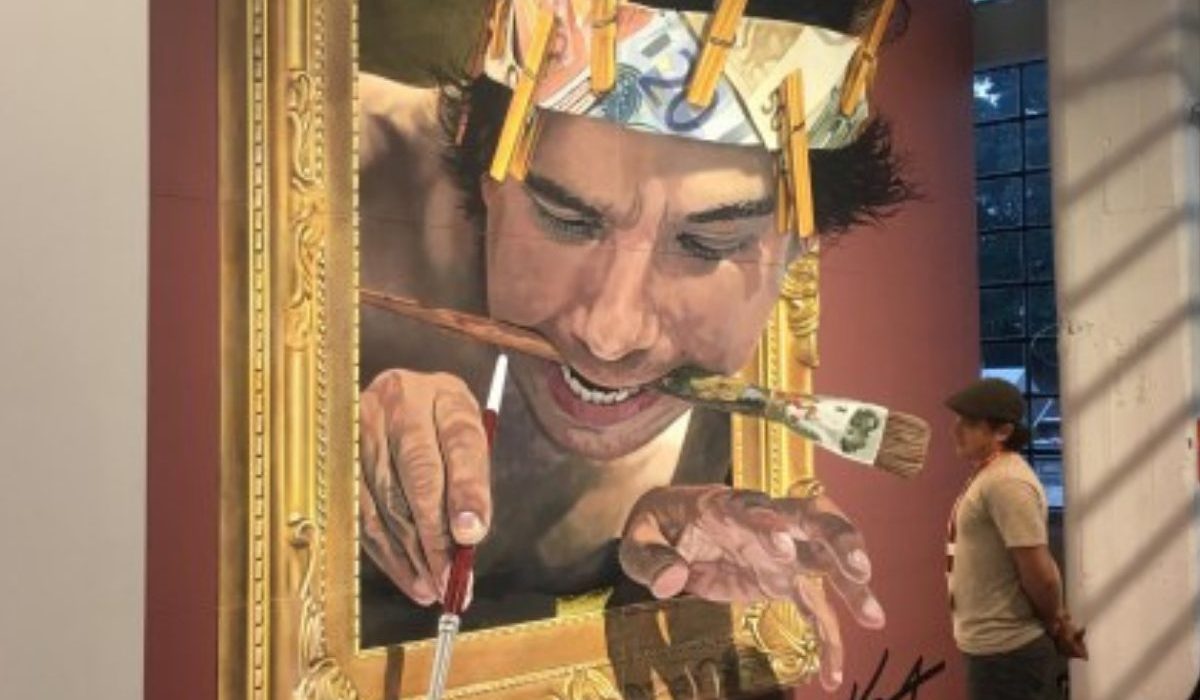
By Guinness World Record Holder, 3D artist from Mexico — Juandres Vera — blends shades of realism with artistic aesthetics to create vivid anamorphic scenes on walls and streets of the world. Through imaginative metaphors, analogies and allegories he depicts facets from life, religion and politics in his work. A recipient of several awards, his work, has been exhibited in museums and galleries around the world. He has been a regular at the Dubai Canvas Festival since its inception. Aligning with this year’s theme of — “Travelling through Art” – the artist has painted two illusionary scenes centred on flying with a suitcase and relaxing in a hammock. In this interview he speaks about the challenges and pleasures of merging realism into street art:

Why is realism an important aspect of your art?
Realism, for me, is a tool to express and cope with almost any thought or emotion that exists in the world. I define my art therefore as synthetic realism, because I have made a fusion of both the realistic style and also of the various subjects in this genre of the art world. I have painted as many themes as I could — including landscapes, still life, body figures, portraits among others.
How do you weave in metaphors, allegories and analogies to address global issues through your art?
By using rhetorical devices depicting basic elements of this field, using them as universal codes and symbols. For instance when I painted a 3D art of a big mouth swallowing a pill to spread environmental awareness in Chiang Mai, Thailand in 2012, the idea was to create awareness about climate change. I pictured the earth as a sick woman needing a medicine. The allegory was to depict Mother Earth as the sick woman in a hyperbolic manner as a giant sized mouth. The green pill represented the recycling culture as a saviour. The finished 3D effect gave viewers the immersive interaction of putting the pill into her mouth, popping out of the ground.

What are the pleasures and challenges of making art on the street or in open areas? Do you think street art is dying?
Street art is not dying; I feel it’s just the opposite. If the city is a concrete jungle, then street art are its flowers, yes they die, but they also bloom every day. I am living a dream as an artist because it lets me to travel and meet new people and know about their cultures. The challenges are always the bad weather, getting permits to work in certain areas and enduring fatigue working outdoors.
What do you want viewers to take away from your art?
I want them to enjoy the immersive experience of 3D art, to make them realise that artwork is not complete without them posing on it.
Tell us about your association with Dubai Canvas?
I have been invited five times to this event, from the very first edition until the latest one, and that is a great honour for me. For this year’s theme I wanted to showcase the beauty of travel. Even though travel is not very easy today we should not forget that each trip first starts in our minds. I urge people to let loose their imagination while exploring new places and creating new realities in their dreams. Art is also a great tool to make this happen. My most cherished art project has been winning the Dubai Canvas price of 2017.

Was art a part of your childhood?
I was born and raised in a lower middle class home in Monterrey, Mexico. During my childhood art was mainly present as cartoons on TV and through other shows such as Bob Ross’s Joy of painting. As long as I can remember I had the talent for drawing, but there wasn’t any role model as a professional painter in my family.
How did your artistic career begin?
I studied Bachelors in Fine Arts with specialty in camera man arts at the Faculty of Visual Arts, UANL, Monterrey, Mexico. I took a break for a year and a half from my studies but later went back to finish my degree. My career as a painter started during the third semester when I entered a street art competition and won a prize. This led to more commissions for murals and paintings on canvas.
Throw light on your artistic process?
It always starts with a clear idea of the theme, the space and the canvas where I am going to paint. Then I make sketches until I see something I like. After that I prepare a design to scale it to the actual canvas. The rest of the process involves tracing, outlining and colouring of the painting.
Tell us about your Guinness record, when and what was it for?
It was an ephemeral anamorphic street painting called Connecting Dots done in Lelystad, Holland in 2013 as part of a team of six artists from Planet Street Painting. We painted 140 meters in length by 7 meters in width.
*All pics supplied by the artist.
#2Dart, #3Dart, #3DartDubai, #Citywalk, #DubaiCanvas, #DubaiCanvas2020, #illusionaryart, #Juandresvera, #streetart